

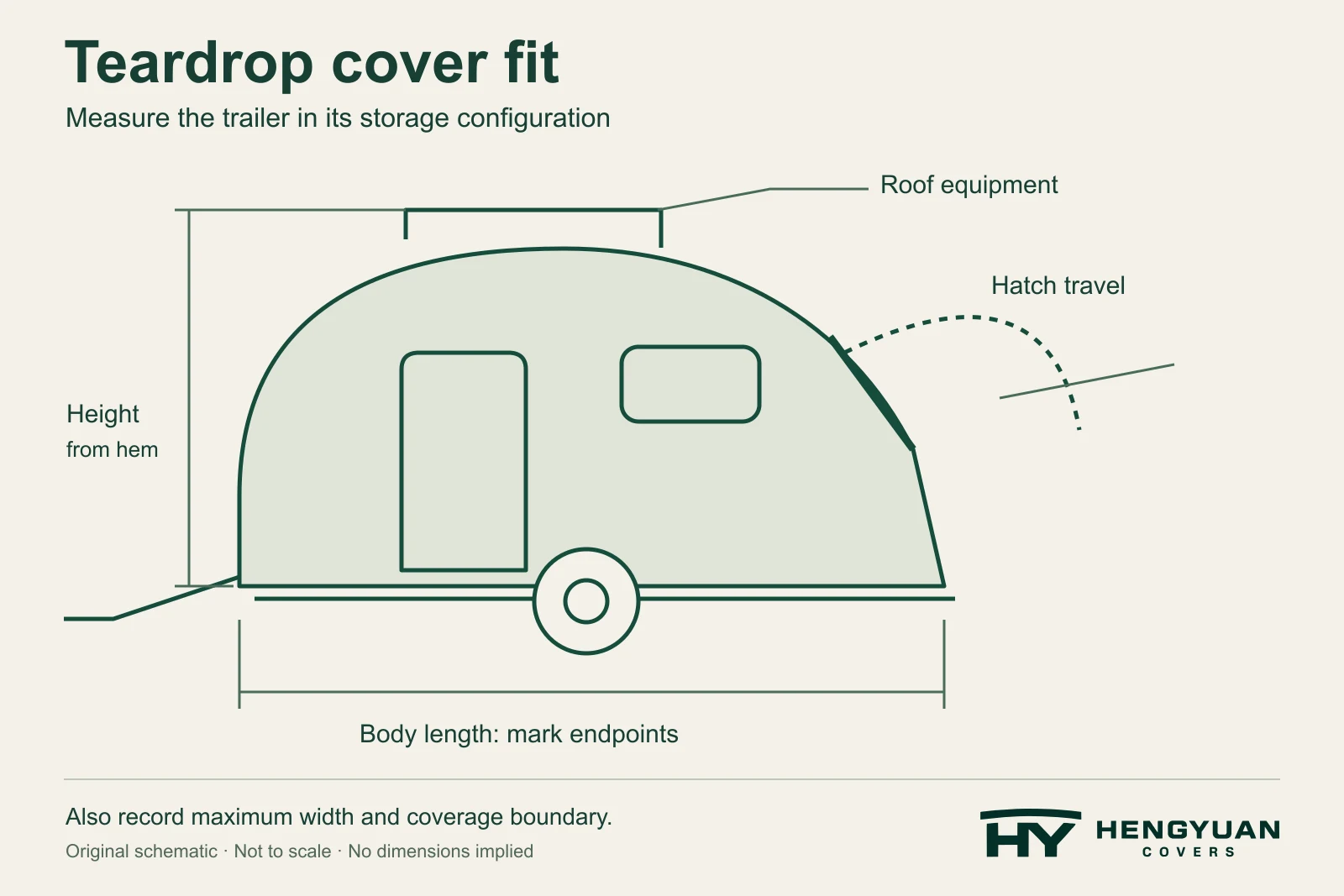
A teardrop trailer cover should be specified from the trailer’s actual storage shape, including the accessories that remain fitted. Body length alone cannot establish the right fit. For an OEM or private-label range, the most useful starting point is a marked drawing showing the coverage boundary, roof profile, maximum width, access points and fastening positions.
This FAQ explains how brands, importers and distributors can turn those details into a sample review. Hengyuan’s teardrop trailer cover program includes universal size ranges and custom patterns, with materials and construction reviewed against the project specification. The aim is to define a repeatable fit before confirming the order.
The illustrations in this guide are original measurement and review aids. They do not represent a particular trailer model, a finished pattern or a tested performance rating.
Which length should we use: body length or total trailer length?
Record both, then state which one defines the cover. “Overall length” may include the tongue, coupling or a front storage box, while the cover may stop at the trailer body. A dimension without its endpoints can therefore produce a different interpretation between the buyer and the pattern developer.
Mark the front and rear coverage limits on a side photograph. Measure the body between those points, record total trailer length separately, and identify any items outside the main cover. Add the intended lower hem position. Do not add an arbitrary fitting allowance to the measurements: supply the actual dimensions and let the allowance be agreed during pattern development.
What measurements matter beyond length?
Provide maximum body width, the widest point including any covered fenders, and height from the agreed hem line to the highest covered feature. Record the height of the front, roof peak and rear at identifiable points along the body. These positions describe the curved profile more usefully than one maximum height.
Use a consistent unit throughout the drawing. Label each measurement and include photographs of both sides, the front, rear and roof. A tape in a photograph can help explain a measurement, but it should support a written dimension rather than replace it. Note left-to-right differences such as a side-mounted accessory or an offset door.
Should roof racks, vents and front boxes be included?
Include every component that remains installed during storage, with its position, dimensions and contact points. Roof racks, vent housings, solar equipment and front boxes can change where the fabric rests or where a seam would land. Identify removable items separately, so the sample is reviewed in the same configuration the end user will actually cover.
Send accessory instructions where available. Decide which components the main cover encloses and which require a separate item. If the tongue jack sits outside the body cover, review a separate electric tongue jack cover rather than assuming the body pattern also fits its controls and cables. Record these decisions in the packing list and product instructions.
Can the rear hatch or side door remain accessible?
Access needs to be designed around movement. Show the door hinges, handle, opening direction and maximum hatch travel. An opening that aligns with a closed door may still interfere when the door swings outward or when the rear hatch rises. Mark where the opened cover panel will be held so it does not fall against the user or drag on the ground.
During sampling, check zipper reach, clearance from corners and hardware, and whether a person can secure the panel without excessive stretching. Document access only for the intended parked storage use. A door opening in a cover does not establish that the trailer can be occupied or that appliances can operate while covered.
How should straps, hems and contact areas be reviewed?
Identify proposed strap routes on underside photographs. Check them against the actual trailer layout and manufacturer instructions; do not leave the installer to choose a route around cables, pipework, hot components or moving equipment. Agree where buckles sit, how adjustment can be reached, and how loose strap ends are retained.
Inspect the fitted sample for concentrated tension at roof fittings, hatch corners and projecting parts. Mark areas needing a different seam position, clearance or reinforcement. The hem should follow the agreed coverage boundary without obstructing wheels or required service points. Describe the fit in measurable terms and photographs rather than approving it solely as “tight” or “heavy duty.”
Can one cover size fit several teardrop models?
Possibly, but a shared length label is insufficient evidence. Build a model comparison sheet with body dimensions, roof profiles, accessory layouts and access positions. Two trailers of similar length can require different allowances at the roof, fenders or rear hatch. Define which variants the proposed size is intended to cover.
For a universal range, agree representative fit checks across the proposed envelope, including the configurations most likely to expose excess fabric or insufficient clearance. Keep the compatibility list tied to the reviewed configurations. For a custom pattern, identify the model, year or drawing revision used for approval. Do not extend a compatibility claim to an unreviewed variant merely because it looks similar.
Does choosing a fabric settle outdoor storage performance?
No. Fabric selection is one part of the specification. Exposure, seam construction, openings, fastening and the installed shape also need review. State the destination environment and the protection priorities, then agree any required material or finished-cover evidence. Do not convert a fabric description into a claim about a completed cover without supporting information.
Care instructions must match the selected material. For example, Sunbrella’s official cleaning guide specifies treatments by type of spill or mess; it is a material-specific reference, not a cleaning recipe for every cover. Its inclusion here does not mean Hengyuan supplies that fabric. Confirm the actual cover’s cleaning, drying and storage instructions with its approved specification.
Is a storage cover suitable for towing or equipment operation?
A storage brief does not establish suitability for towing. Treat road use as a separate application requiring its own design requirements and validation. Likewise, do not assume that access panels or cover ventilation allow heating, cooking, charging or other equipment to operate underneath it. Follow the trailer and component manufacturers’ instructions for the exact storage arrangement.
The trailer itself also needs the manufacturer’s storage preparation and periodic checks. A cover does not replace that work. Ask the brand’s instructions to distinguish trailer maintenance from cover care, explain the intended parked use, and tell the user how to remove and refit the cover for inspections.
What should we approve before a production order?
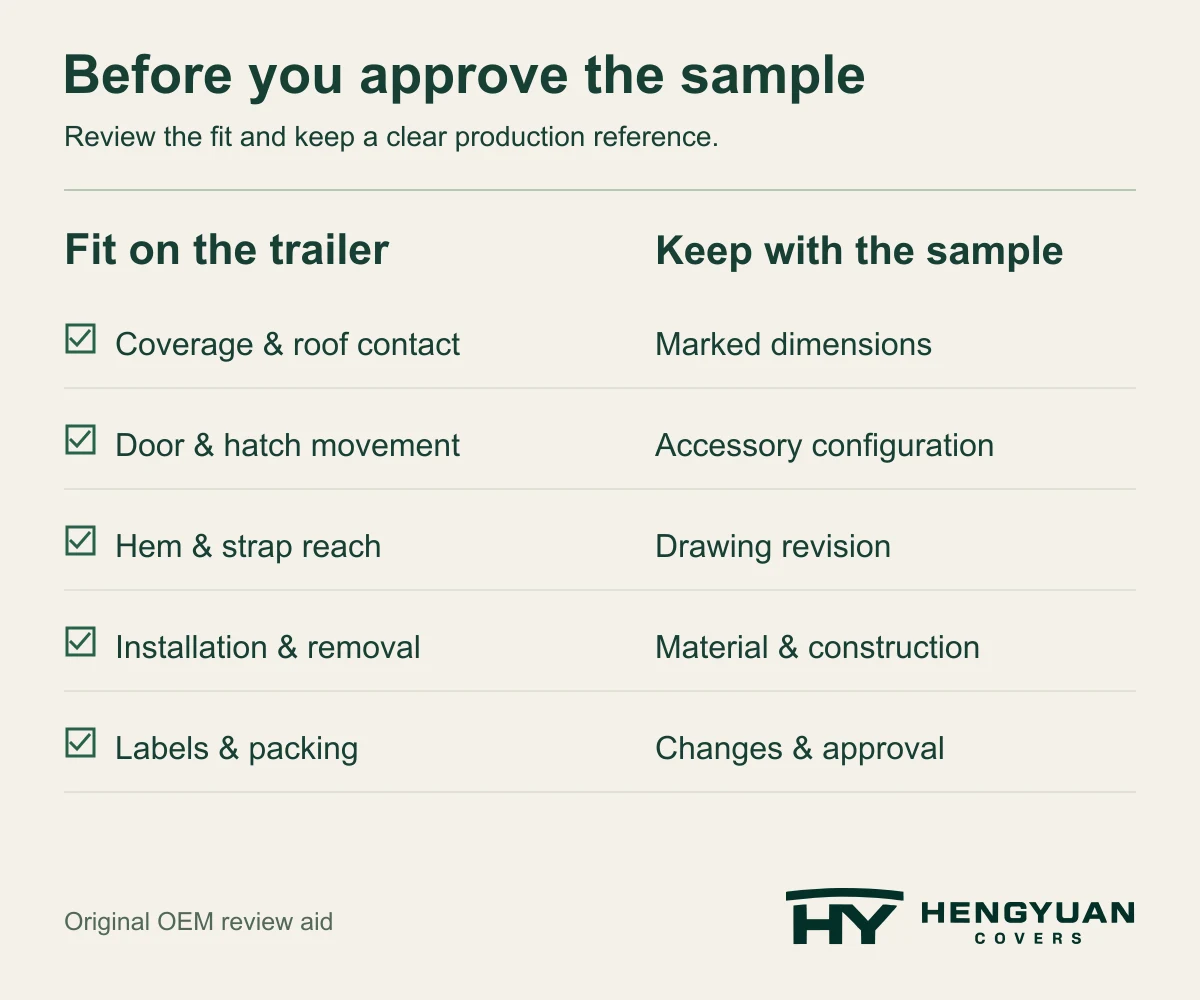
Review the sample on the intended trailer configuration wherever practical. Photograph all sides, roof contact points, closed and opened access panels, the hem and securing details. Record every change against a dated drawing revision, then confirm whether a revised sample or another fit check is needed. An unclosed comment should not disappear into a general approval email.
- Keep the dimensional drawing, accessory list and coverage boundary with the sample reference.
- Confirm fabric identification, construction details, agreed checks and acceptance criteria.
- Approve labels, logo placement, storage bag, instructions and packaging for each size.
- Record the sample revision and which trailer configurations were actually reviewed.
Hengyuan’s custom cover development process connects dimensions, pattern work, material review and sampling with the specification for repeat orders. To begin a teardrop cover project, send marked photographs or drawings, the storage configuration, estimated quantity by size and destination market through our quotation form. This gives the team a concrete basis for reviewing the fit and remaining development questions.
Prepared by Hengyuan Covers with AI-assisted drafting and editorial review. Illustrations are original explanatory diagrams using the official Hengyuan logo. General storage and accessory considerations were checked against original trailer manufacturer documentation; the instructions for your own trailer and components remain the reference for their use.
Custom Cover Enquiry
Discuss Your Custom Cover Project
Share your product, dimensions, intended use and order quantity. Our team can review your requirements for an OEM or private-label quotation.
Request a Quote